


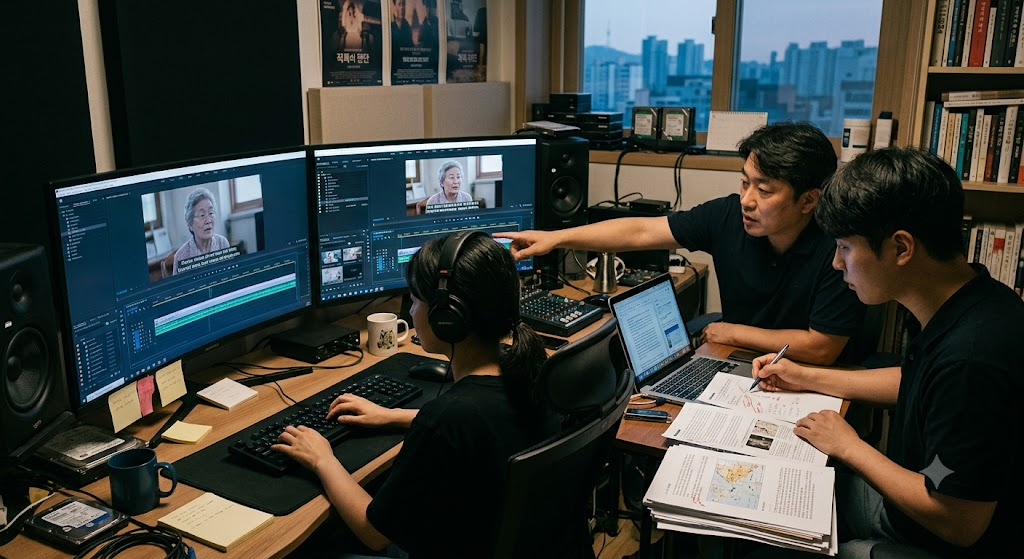
Most people picture a documentary as cameras and interviews. Yet a large share of the work happens afterwards, in quiet rooms where footage becomes a finished film. When the language of the material differs from the language of the audience, this stage needs extra care and a little humility.
The Footage Is Only the Beginning
A day of interviews can produce hours of material, much of it in Korean. Before the edit can start, someone has to understand what was said, find the strongest moments and decide how they fit together.
That is why planning for post-production should begin before the shoot. Knowing how much translation you will need shapes budgets, schedules and even which questions are worth asking on the day.
Transcription: The Foundation
A careful transcript in the original language is the first layer. It lets editors, producers and translators search for lines quickly and agree on exactly what was said, rather than trusting memory.
Time-coded transcripts are especially useful. Each sentence is linked to its place in the footage, so a producer can jump straight to a quotation and check the facial expression that came with it.
Translation Is More Than Words
Korean often relies on context, politeness levels and omitted subjects. A literal English version can sound blunt, confusing or even rude, even when every word is technically correct.
Good translators capture meaning and tone together. A documentary fixer South Korea crews work with can review difficult passages, explaining idioms, cultural references and the emotional weight behind a seemingly simple phrase.
Subtitles That People Can Read
Subtitles must be short enough to read while the viewer still watches the picture. Most audiences cope with about two lines at a time, and they need those lines to stay long enough on screen.
Editors balance accuracy against speed, trimming repetition and filler. The goal is to let the viewer feel the person speaking, not to produce a perfect word-for-word copy that nobody has time to finish.
Fact-Checking Every Claim
Documentaries are trusted because audiences assume the facts are correct. Dates, names, numbers and descriptions of events should all be checked against reliable, independent sources before release.
Keep a simple log listing each claim, the source and who confirmed it. If a legal or ethical question arises later, that record shows that the film was made carefully and in good faith.
Archive and Music Rights
Old photographs, news clips and songs add depth, but they also carry rights that must be cleared. Using something without permission can delay a release or force an expensive re-edit.
Complete film production services include research into archive material and the paperwork to license it properly. Planning this early prevents a favourite scene from being cut at the last minute.
Checking With Contributors
When a film features real people, many producers share the relevant subtitles or sections with them before release. This is not about giving up editorial control; it is about catching errors and avoiding hurt.
A short conversation in the contributor’s own language can resolve misunderstandings quickly. It also builds goodwill, which matters when a team hopes to return for another project in the future.
Planning the Schedule Realistically
Translation and subtitling are slower than most newcomers expect. Several rounds of checking, from the first draft to a native-level review, can easily stretch across weeks.
Build that time into the delivery date, not as a vague extra. A realistic schedule prevents panic near the deadline, and it gives translators room to ask questions rather than guess.
Choosing the Right Team
A good post-production team combines editors, translators and researchers who respect each other’s skills. Ask who will actually do each task, and what experience they have with Korean material.
Ask for samples of subtitled work, too. Reading a few minutes of finished subtitles reveals how the team thinks about rhythm, tone and accuracy far more clearly than any promise in a proposal.
Building a Reliable Glossary
Names, places and technical terms appear again and again in a documentary. Spelling them differently on screen quickly looks careless, especially with Korean names romanised in several ways.
Keep one shared glossary for the whole project. Translators, editors and graphic designers all consult it, so a contributor’s name looks identical in the credits, the subtitles and the lower-third captions.
Conclusion
Post-production is where a documentary finds its voice for new audiences. Patience, local insight and rigorous checking turn raw footage into something that travels well across languages.
To explore the post-production services offered by a Seoul production company, visit posted-productions.com.