


FIFA international match calendar is the invisible engine that keeps global football synchronized. From World Cup qualifiers to continental championships, every international fixture owes its place to this structured calendar.
If you’ve ever wondered why your favorite club suddenly loses its star striker in September or March, the answer lies in the FIFA international match calendar. It is not just a schedule; it’s a carefully negotiated agreement balancing national pride, club commitments, player welfare, and commercial realities.
In this guide, we’ll explore how the system works, why it matters, and how it shapes modern football across continents.
Table of Contents
ToggleUnderstanding the FIFA international match calendar
At its core, the FIFA international match calendar defines specific windows during which national teams can call up players from their clubs. These windows are mandatory release periods, meaning clubs must allow players to represent their countries.
The governing body behind this structure is FIFA, headquartered in Zurich. Working alongside continental confederations like UEFA and CONMEBOL, FIFA coordinates dates years in advance.
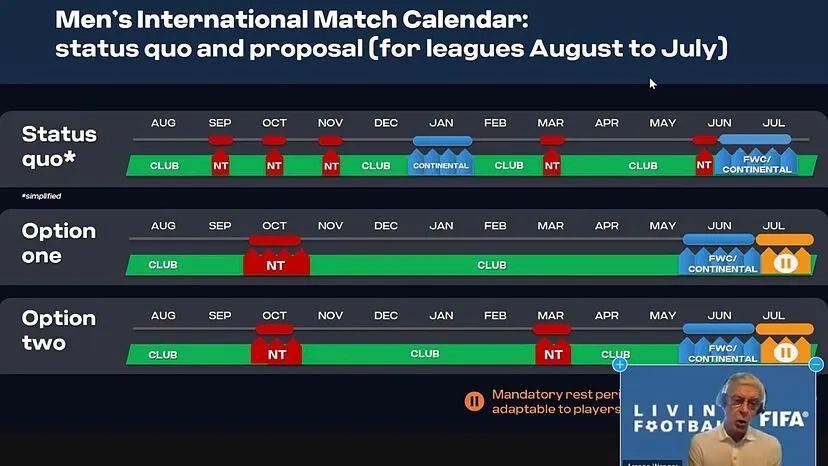
Typically, the calendar includes several international breaks across the season, often in September, October, November, March, and June. These windows host friendlies, qualifiers, and tournaments depending on the competition cycle.
The reason for such planning is simple: global football is interconnected. Without a centralized calendar, club and international football would clash endlessly.
Why the FIFA international match calendar Exists
Before the modern system, international fixtures were chaotic. Clubs often resisted releasing players, especially during critical domestic matches. Disputes were common, and national teams struggled with availability.
The FIFA international match calendar was introduced to create predictability. It ensures fairness so that every country can access its best players during official competitions.
For example, when qualifiers for the FIFA World Cup take place, all nations operate under the same release rules. This eliminates competitive imbalance.
Beyond fairness, the calendar also supports commercial agreements. Broadcasters, sponsors, and ticketing platforms rely on fixed dates. Stability strengthens the global football economy.
How the FIFA international match calendar Impacts Clubs
For club managers, the FIFA international match calendar can be both a blessing and a headache.
On one hand, international exposure increases a player’s market value. A breakout performance in a national jersey can elevate a club’s global brand. Think about how young players gain recognition during international tournaments.
On the other hand, there are risks. Travel fatigue, injuries, and disrupted training routines are real concerns. A club fighting for a league title may suddenly lose key players for two weeks.
Consider the English Premier League. Clubs competing domestically and in Europe often see players travel across continents during international breaks. A defender might fly from London to South America and back within days.
This tension between club priorities and national duties is one of the most debated aspects of the FIFA international match calendar.
Player Welfare and the FIFA international match calendar
Modern footballers play more matches than ever before. Domestic leagues, continental competitions, cup tournaments, and national fixtures all compete for space.
The FIFA international match calendar attempts to manage this load. Recent revisions have aimed to reduce fragmented travel by grouping matches within single windows.
Player unions have repeatedly raised concerns about burnout. Research shows that excessive match exposure increases injury risks. By clustering fixtures, the calendar tries to balance competitive needs with physical health.
Still, critics argue that international tournaments expanded in recent years add further strain. The debate around workload continues to shape discussions about future adjustments.
Evolution of the FIFA international match calendar
The FIFA international match calendar has evolved significantly over the decades.
In earlier eras, international friendlies were scattered unpredictably. As global broadcasting grew, the need for coordination intensified. The system we see today reflects decades of negotiation between FIFA, confederations, leagues, and player associations.
Major tournaments like the UEFA European Championship and the Copa América require long-term planning. Host countries prepare infrastructure years ahead, and qualifiers must fit seamlessly into domestic seasons.
The expansion of competitions has also influenced calendar reform. As more teams participate in global tournaments, scheduling complexity increases.
The modern FIFA international match calendar is essentially a diplomatic compromise shaped by football’s global growth.
FIFA international match calendar and Global Tournaments
Every four years, the football world revolves around the FIFA World Cup. Qualifiers stretch across multiple international windows, sometimes spanning two years.
The FIFA international match calendar ensures that these qualification rounds do not collide with club tournaments like the UEFA Champions League.
Similarly, continental championships are strategically placed during the off-season in many regions. This allows players to represent their countries without overlapping domestic league schedules.
The coordination may seem simple on the surface, but aligning multiple continents with different seasonal structures is complex. European leagues typically run from August to May, while others operate on calendar-year formats.
Balancing these differences is one of the most intricate tasks behind the scenes.
The Business Side of the FIFA international match calendar
Football is more than sport; it’s a multi-billion-dollar industry.
The FIFA international match calendar directly influences broadcasting rights deals. Networks purchase rights based on predictable scheduling. Sponsors align campaigns with international breaks to maximize viewership.
For emerging markets, international windows provide exposure that domestic leagues might not offer. National pride drives high television ratings, especially during qualifiers.
The commercial strength of tournaments like the FIFA World Cup heavily depends on the structured timeline provided by the calendar.
Clubs may express frustration, but financially, the global ecosystem benefits from coordinated international breaks.
Fan Experience and the FIFA international match calendar
Fans often have mixed reactions to international breaks.
Some supporters eagerly anticipate watching their national teams. Others, especially club-focused fans, view these pauses as interruptions.
Yet, the FIFA international match calendar creates shared global moments. A dramatic late goal in a qualifier can unite millions across borders.
International windows also provide opportunities for smaller nations to shine. Countries outside traditional powerhouses can compete on a level field.
For many players, wearing the national jersey is the pinnacle of their career. The emotional value cannot be overstated.
Controversies Surrounding the FIFA international match calendar
No system is perfect, and the FIFA international match calendar has faced criticism.
Clubs argue that they bear financial risks when players return injured. Smaller leagues sometimes struggle when domestic fixtures are rescheduled around international commitments.
There are also debates about expanding global tournaments, which may compress the schedule further.
Negotiations between FIFA and domestic leagues are ongoing. Discussions about reducing the number of windows but increasing match frequency per window have gained traction.
Balancing tradition, commercial interests, and athlete health remains a complex equation.
Future Outlook of the FIFA international match calendar
The future of the FIFA international match calendar will likely reflect technological advancements and shifting commercial priorities.
Data analytics now tracks player fatigue more precisely. Travel logistics are optimized using advanced planning tools. These developments may influence future scheduling decisions.
Global expansion of tournaments suggests further revisions could be on the horizon. Emerging football nations are demanding more competitive opportunities.
At the same time, player welfare organizations push for reduced match congestion.
The system will continue evolving, shaped by negotiation and innovation.
Why the FIFA international match calendar Matters More Than Ever
In a hyper-connected world, football serves as a cultural bridge.
The FIFA international match calendar enables synchronized storytelling across continents. Whether it’s qualification drama, regional rivalry, or global celebration, the structure ensures every match has its place.
Without it, international football would descend into scheduling chaos. Clubs and countries would compete endlessly for control.
Instead, the calendar provides order. It protects competitive integrity while sustaining the global football economy.
From grassroots dreams to World Cup glory, every international fixture exists because this framework makes it possible.
As fans tune in during the next international break, they may not think about logistics, negotiations, or planning cycles. But behind every anthem and kickoff stands the FIFA international match calendar, quietly orchestrating the rhythm of the world’s most beloved sport.
mohun bagan super giant vs punjab fc lineups
kerala blasters vs chennaiyin fc player ratings
chennaiyin fc vs kerala blasters player ratings